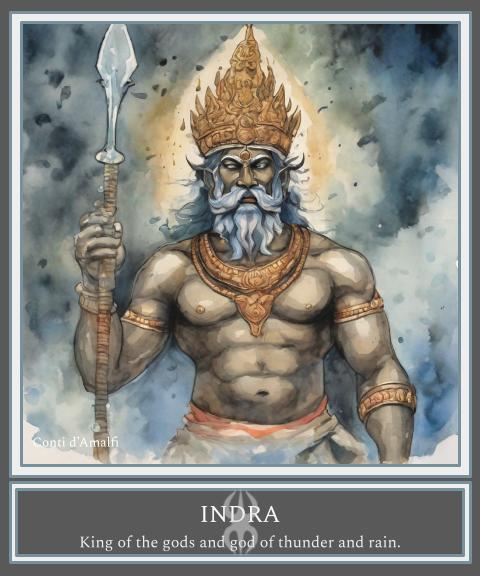
Hindu Mythology | The Adityas


Mitra: God of friendship, contracts, and honesty.

Varuna: God of water, oceans, and cosmic order.

Aryaman: God of nobility, hospitality, and contracts.

Bhaga: God of wealth and fortune.

Daksha: God of skill and craftsmanship.

Amshuman: God associated with the river and the ocean.

Bhaskara: Another name for the Sun god, Surya.

Savitr: God of the sun, creativity, and inspiration.

Tvashtri: God of divine craftsmanship and architectural skill.

Vishnu: The preserver and sustainer of the universe.

Vivasvat: Another name for the Sun god, Surya.

Comments

Popular posts from this blog

Instructions of Shuruppak

Ubara-Tutu is recorded in most copies of the  Sumerian King List  as being the final king of Sumer prior to the  deluge . Ubara-tutu is briefly mentioned in  tablet XI  of the  Epic of Gilgamesh , where he is identified as the father of  Utnapishtim , a character who is instructed by the god  Ea  to build a boat in order to survive the coming flood.     Utnapishtim  ( Akkadian :  𒌓𒍣 , "he has found life") was a legendary king of the ancient city of  Shuruppak  in southern Iraq, who, according to the  Gilgamesh flood myth , one of several similar narratives, survived  the Flood  by making and occupying a boat.  He is called by different names in different traditions:  Ziusudra  ("Life of long days", rendered Xisuthros, Ξίσουθρος in  Berossus ) in the earliest, Sumerian versions, later Shuruppak (after his city),  Atra-hasis  ("exceeding wise") in the earliest  Ak...

The 14th Baktun

The concept of "14 Baktuns" in the Mayan Long Count calendar refers to the period following the completion of the 13th Baktun, which ended on December 21, 2012. The Long Count calendar is a non-repeating system used by the Maya to track time over long periods. It consists of several units, with the Baktun being one of the largest, representing 144,000 days (approximately 394.25 years ) [1] . The confusion surrounding the Mayan Long Count calendar and the transition from the 13th to the 14th Baktun arises from how different sources interpret the significance of December 21, 2012.  End of the 13th Baktun: December 21, 2012 This date was widely publicized and often misinterpreted as an "end of the world" scenario in popular culture. Following the completion of the 13th Baktun, the Long Count calendar transitioned to 14.0.0.0.0 . This beginning signifies a new cycle, and it is indeed the current point in the Long Count. Many interpretations of the Mayan calendar focus...

Meditation on Numbers

  ONE In  Hermetic  philosophy, the number 1 represents the Monad, the primordial unity from which all creation springs. It symbolizes the Absolute, the unmanifest Source, the Divine Oneness that precedes all differentiation. The Monad is seen as the origin of all numbers and the foundation of the cosmos. In  Jewish Kabbalah , the number 1 is associated with the concept of Ein Sof, the unknowable, infinite, and absolute Divine essence. It represents the singular, indivisible nature of the divine, emphasizing the unity and oneness of the divine source. In  Taoism , the number 1 is associated with the Tao, the ultimate, ineffable source of all existence. The Tao is seen as the singular, undifferentiated primal reality from which the myriad manifestations of the universe arise. The number 1 points to the inherent unity and wholeness of the Tao. Similarly, in  Buddhism , the number 1 can symbolize the non-dual nature of reality, the seamless oneness of all phen...