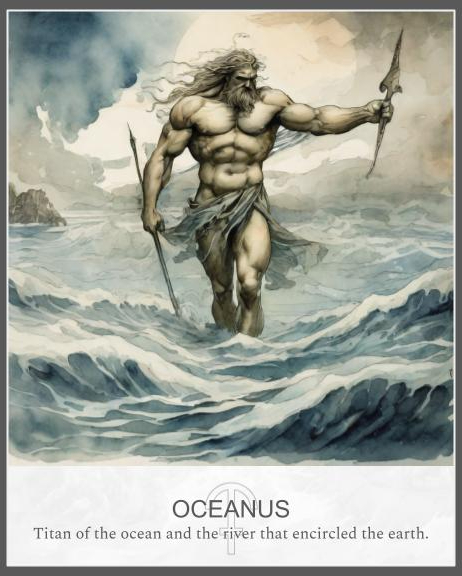
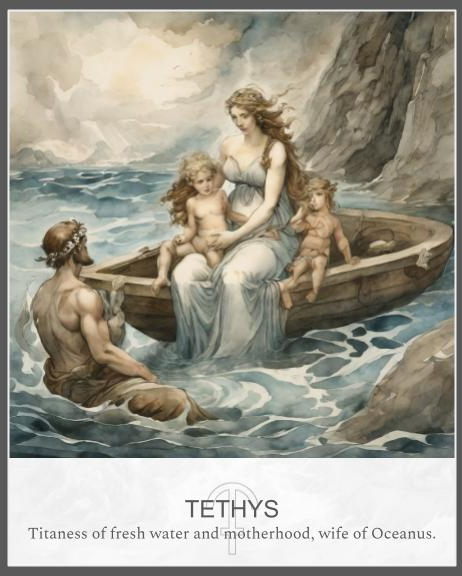
Greek Mythology | Twelve Titans


Hyperion: Titan of light and the father of the sun, moon, and dawn.

Theia: Titaness of sight and heavenly light.

Coeus: Titan of intellect and the axis of heaven.

Phoebe: Titaness associated with prophecy and intellect.

Cronus: Titan of time and the leader of the Titans. He later overthrown by his son, Zeus.

Rhea: Titaness of fertility and motherhood, and wife of Cronus.

Mnemosyne: Titaness of memory and the mother of the nine Muses.

Themis: Titaness of divine law and order.

Crius: Titan associated with the constellations and cosmic order.

Iapetus: Titan associated with mortality and human life.

Comments

Popular posts from this blog

Instructions of Shuruppak

Ubara-Tutu is recorded in most copies of the  Sumerian King List  as being the final king of Sumer prior to the  deluge . Ubara-tutu is briefly mentioned in  tablet XI  of the  Epic of Gilgamesh , where he is identified as the father of  Utnapishtim , a character who is instructed by the god  Ea  to build a boat in order to survive the coming flood.     Utnapishtim  ( Akkadian :  𒌓𒍣 , "he has found life") was a legendary king of the ancient city of  Shuruppak  in southern Iraq, who, according to the  Gilgamesh flood myth , one of several similar narratives, survived  the Flood  by making and occupying a boat.  He is called by different names in different traditions:  Ziusudra  ("Life of long days", rendered Xisuthros, Ξίσουθρος in  Berossus ) in the earliest, Sumerian versions, later Shuruppak (after his city),  Atra-hasis  ("exceeding wise") in the earliest  Ak...

The 14th Baktun

The concept of "14 Baktuns" in the Mayan Long Count calendar refers to the period following the completion of the 13th Baktun, which ended on December 21, 2012. The Long Count calendar is a non-repeating system used by the Maya to track time over long periods. It consists of several units, with the Baktun being one of the largest, representing 144,000 days (approximately 394.25 years ) [1] . The confusion surrounding the Mayan Long Count calendar and the transition from the 13th to the 14th Baktun arises from how different sources interpret the significance of December 21, 2012.  End of the 13th Baktun: December 21, 2012 This date was widely publicized and often misinterpreted as an "end of the world" scenario in popular culture. Following the completion of the 13th Baktun, the Long Count calendar transitioned to 14.0.0.0.0 . This beginning signifies a new cycle, and it is indeed the current point in the Long Count. Many interpretations of the Mayan calendar focus...

Giordano Bruno | l'infinito universo

  Giordano Bruno (1548-1600) was an Italian philosopher, mathematician, poet, and astronomer who is renowned for his extensive writings and controversial ideas. He made significant contributions to various fields, including cosmology, philosophy, and the art of memory. Bruno's works challenged established religious and philosophical doctrines of his time and had a profound impact on the development of modern thought. "On the Infinite Universe and Worlds"  (De l'infinito universo et mondi): In this work, published in 1584, Bruno argues for the existence of an infinite universe with an infinite number of inhabited worlds. He rejected the geocentric model of the universe and proposed a heliocentric system, asserting that the Earth orbits the Sun alongside other celestial bodies. Bruno's ideas anticipated the concept of an infinite and diverse cosmos, which was revolutionary for the time. "The Ash Wednesday Supper"  (La cena de le ceneri): Published in 1584,...